India and Europe are fast shifting away from a traditional free trade agreement and toward a more integrated artificial intelligence and advanced technology collaboration.Indian Defense Analysis
At the heart of this change is a rising convergence of semiconductor production, AI research, digital infrastructure, and regulatory frameworks, resulting in interwoven ecosystems that could impact innovation on both continents for decades.
In May 2026, TATA Electronics announced a strategic collaboration arrangement with Dutch semiconductor equipment manufacturer ASML to support India’s first commercial 300 mm semiconductor production facility in Dholera, Gujarat.
The fab, worth over ₹91,000 crore, can produce up to 50,000 wafers per month and create chips in process nodes from 28 nm to 110 nm for automotive, mobile, communications, and AI applications.
The relationship extends beyond equipment provision. ASML will deliver sophisticated lithography technologies, promote workforce development, boost supply chains, and contribute to the research capabilities needed for India’s semiconductor ecosystem to succeed in the long run. The project is one of India’s most critical efforts toward establishing a domestic chip manufacturing base.
At the same time, India and France have increased their collaboration in AI-enabled healthcare through the Indo-French Center for AI in Health at AIIMS Delhi. The center, created in collaboration with Sorbonne University and the Paris Brain Institute, focuses on AI-driven diagnostics, multimodal brain biomarkers, and low-field MRI technologies capab
le of providing inexpensive and scalable medical imaging solutions throughout India.
European investments in India’s AI infrastructure are also increasing. Submer, a Spanish technology company, has invested approximately ₹19,000 crore in a large AI-ready data center campus near Bhopal, Madhya Pradesh.
The project is planned to provide up to 1 GW of liquid-cooled computing capacity while also providing thousands of direct and indirect job opportunities. The investment is one of the largest European investments to AI and digital infrastructure in India, reflecting the increased need for high-performance computing resources needed for advanced AI applications.Germany has emerged as another important partner.
During the AI Impact Summit in New Delhi in February 2026, India and Germany signed an AI Pact to advance industrial AI adoption in manufacturing, mobility, energy, healthcare, and other important areas.
The agreement also encourages collaboration on trustworthy AI, talent mobility, research infrastructure, sector-specific AI models, and conversations about implementing the EU AI Act alongside India’s AI Mission.Indian Defense Analysis
The India-EU Free Trade Agreement, signed in January 2026, serves as a broader foundation for these endeavors. The pact increases technology cooperation by establishing formal channels between European and Indian AI authorities, fostering collaboration on AI governance, safety standards, and innovation.
It also encourages conversations about India’s partnership with Horizon Europe, the European Union’s €93.5 billion research and innovation program, which could provide Indian institutions and businesses with greater access to joint research opportunities across Europe.
Along with this endeavor, a European Legal Gateway Office will be established to help Indian ICT professionals, researchers, and technical talent transfer to European laboratories, universities, and industrial research centers.
Taken together, these developments point to a partnership that goes much beyond standard outsourcing models. The new relationship is increasingly defined by collaborative semiconductor production, shared AI research, common innovation frameworks, advanced computing infrastructure, healthcare collaboration, and regulatory coordination.
Rather than operating as independent technology ecosystems, India and Europe are gradually developing integrated capabilities spanning chips, computation, talent, research, and AI governance, resulting in a long-term strategic technology alignment that will have long-term consequences.
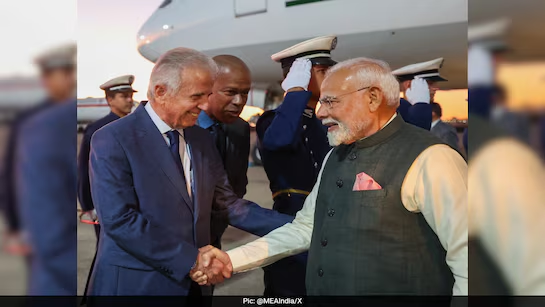
Swiss President Guy Parmelin receives a ceremonial welcome as India-Switzerland relations enter a new growth phase.