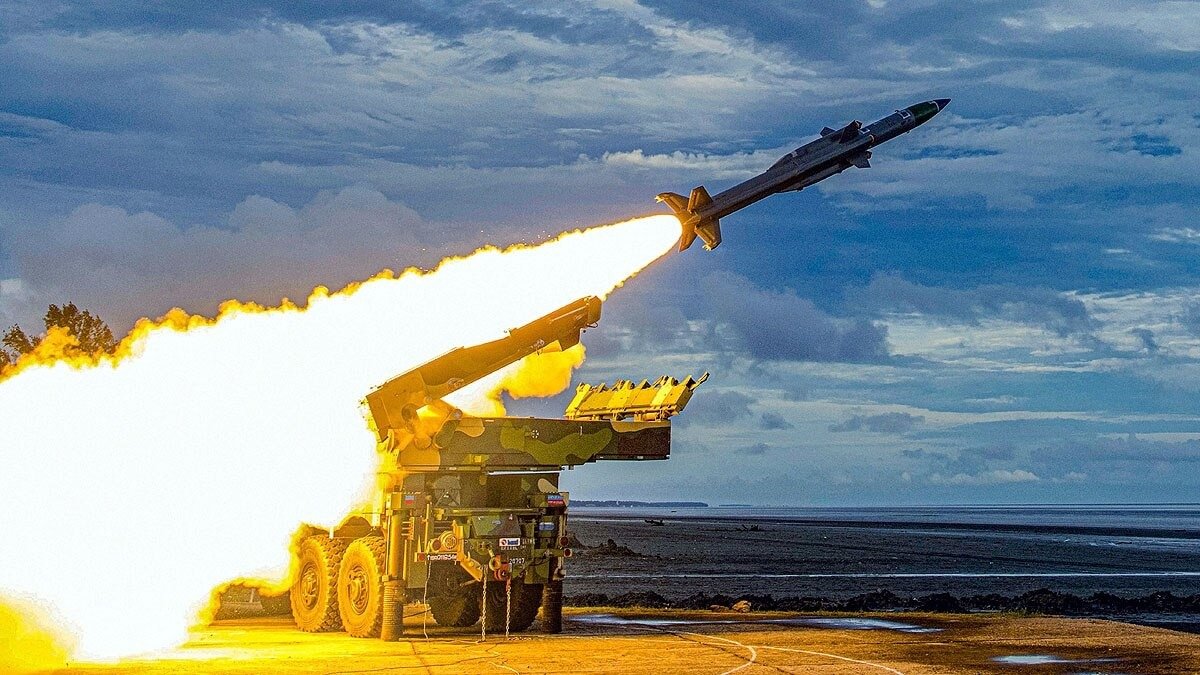
In his speech at the Air Force Commanders’ Conclave in New Delhi on December 19, 2025, Defense Minister Rajnath Singh emphasized the critical role that the domestic Sudarshan Chakra air defense system plays in strengthening the country’s security framework.
According to him, the Sudarshan Chakra is a game-changer that will greatly improve India’s multi-layered air defense capabilities by seamlessly integrating command-and-control systems, weapons platforms, and sensors.
Prime Minister Narendra Modi originally revealed this cutting-edge network on Independence Day, highlighting India’s dedication to defense technology independence by promising quicker and more coordinated responses to aerial threats.
Singh asked commanders of the Indian Air Force to learn important lessons from Operation Sindoor, a recent operation that demonstrated the legitimacy and efficacy of the nation’s air defense system.
Pakistan’s attempt to strike Indian installations during Operation Sindoor failed to interfere with day-to-day operations, demonstrating the strength of India’s defenses and the public’s steadfast faith in its military.
The Minister pointed out that this kind of public restraint during stressful times shows a strong belief in the military’s preparedness and ability to protect the country.
He commended the Indian Air Force for being a technologically sophisticated and strategically confident force that is prepared to provide accurate responses in all types of contemporary wars.
Senior defense officials who attended the summit, such as Air Chief Marshal A.P. Singh and Chief of Defence Staff General Anil Chauhan, emphasized its importance in determining future military tactics.
Singh cited the changing security environment and urged constant watchfulness in the face of swift geopolitical changes and technological upheavals.
Singh cited high-profile wars including the Russia-Ukraine war, the Israel-Hamas conflict, the Balakot airstrike, and Operation Sindoor to illustrate the strategic importance of air force in modern warfare.
These examples show how air power, which uses speed, surprise, and accuracy to change battlefield dynamics, has evolved beyond tactical applications to become a crucial tool of strategy.
He emphasized that areas like cyberwarfare, artificial intelligence, unmanned aerial systems, satellite surveillance, and space-based assets will become increasingly important in future battles.
In keeping with the ‘Atmanirbhar Bharat’ strategy to strengthen national security and lessen reliance on foreign technology, indigenous innovation is still crucial.
Citing Operation Sindoor as a model for tri-service coordination, Singh argued for increased cooperation between the Army, Navy, and Air Force.
He contended that in the years to come, this kind of cooperation will be crucial for combating complex dangers and guaranteeing a cohesive response to both traditional and hybrid problems.
The development of the Sudarshan Chakra is in line with larger initiatives to build an impenetrable air defense shield that can neutralize aircraft, missiles, and drones through multi-layered interception.
It will enable real-time threat assessment and quick engagement by combining state-of-the-art sensors with automated command systems, reducing response times in high-intensity situations.
In addition to addressing current aerial weaknesses, this system establishes India as a pioneer in cutting-edge defense technologies.
The government’s ambition for a future-ready air force that combines cutting-edge missile defenses with domestic platforms like the Tejas aircraft is reaffirmed in Singh’s speech.
The accomplishment of Operation Sindoor, which successfully stopped Pakistani intrusions, has raised spirits and validated investments in domestic systems.
A crucial factor in maintaining national resolve during crises is the public’s calm during the operation, which indicates strong community trust in the armed services.
The Sudarshan Chakra becomes a key component of deterrence as India negotiates conflicts with neighbors like China and Pakistan.
The Minister urges the air force to lead the way in AI-driven targeting and hypersonic countermeasures as part of his push for innovation in new technologies.
To create a smooth tri-service environment, cooperative exercises and interoperability standards must develop, expanding on Operation Sindoor’s paradigm.
Air superiority determined the outcome of the Russia-Ukraine conflict, a lesson India has learned from Balakot and other events.
The interactions between Israel and Hamas serve as more evidence of the importance of targeted strikes in asymmetric and urban warfare.
The air force is inspired for an era of multi-domain operations by Singh’s summit address, which acts as a strategic template.
India’s air defense strategy will change from reactive to proactive as the Sudarshan Chakra approaches, guaranteeing sovereignty in an increasingly disputed airspace.
India’s position among the world’s military powers is expected to improve as a result of this development and self-reliance initiatives.