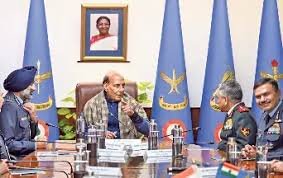
Operation Sindoor was crucial in demonstrating India’s superior air power capabilities, according to Defence Minister Rajnath Singh. Speaking on Thursday at the Air Force Commanders’ Conclave in New Delhi, he emphasized how this brief, high-impact operation showed the Indian Air Force’s (IAF) increasing competence in modern warfare.
The IAF is a technologically sophisticated, operationally flexible, strategically assured, and forward-thinking force, according to Mr. Singh. In light of the quickly changing global order, he emphasized its crucial role in defending national interests.
The mission successfully destroyed terror camps, demonstrating the bravery, quickness, and accuracy of IAF personnel. The force’s skillful handling of Pakistan’s following “irresponsible reaction” to the strikes was as noteworthy.
During the incident, the public’s confidence in the armed forces—especially in India’s air defense systems—was evident. Despite attempts to assault Indian installations, the public remained composed, demonstrating a strong belief in the military’s operational readiness.
Air Force commanders were asked by Mr. Singh to draw important conclusions from Operation Sindoor. In order to be prepared for the future, he emphasized the necessity of carefully analyzing the offensive and defensive capabilities of opponents.
The principles of speed, surprise, and shock were critical to the operation’s success. These components made it possible for decisive leadership to coordinate military operations with national goals while communicating unambiguous strategic statements.
Throughout the mission, air defense systems and related equipment operated admirably. The government’s steadfast dedication to strengthening the country’s security apparatus was reiterated by the defense minister.
21st-century warfare is becoming more and more influenced by technology and flexibility. Conflict environments are changing due to emerging fields including cyberwarfare, artificial intelligence, unmanned systems, satellite-based surveillance, and space-enabled capabilities.
Real-time intelligence, data-driven decision-making, and precision-guided weaponry have become essential for operational success. Mr. Singh emphasized them as fundamental principles for the IAF’s continued development.
The minister stated that he had great confidence in future potential. He cited Prime Minister Narendra Modi’s announcement of the Sudarshan Chakra during this year’s Independence Day speech as a crucial protection for national resources.
The creation of domestic jet engines is now considered a national mission. This program is in line with larger initiatives to increase defense manufacturing’s independence.
During Operation Sindoor, cooperation amongst the services proved to be a powerful force multiplier. It is an excellent example of tri-service synergy that promotes integrated operational effectiveness, according to Mr. Singh.
These strategic insights were reinforced at the conclave. It highlighted the IAF’s evolution into a cutting-edge, adaptable force that can handle a variety of threats.
Such air power displays reinforce India’s commitment and discourage aggression in the face of geopolitical unpredictability. Thus, Operation Sindoor is evidence of India’s military doctrine’s development.
The government is still making aggressive investments in defense modernization. These initiatives guarantee that the military stays at the forefront of both operational excellence and technical innovation.