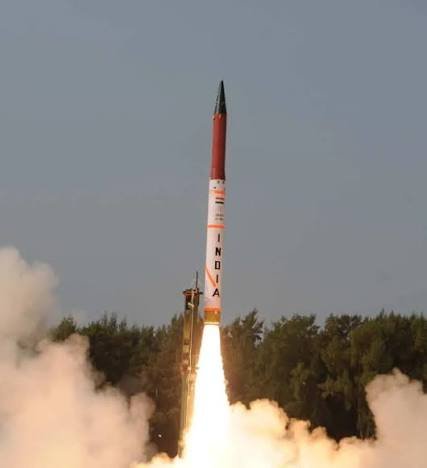
The Strategic Forces Command’s eleventh test of India’s Agni-IV ballistic missile, which took place on August 6, 2026, was more about signaling operational preparedness, credibility, and deterrence stability than it was about new technology.
The sixth user trial of the Agni-IV missile was conducted by India’s Strategic Forces Command, emphasizing that this was a display of combat readiness rather than a developmental exercise.
This distinction is essential for deterrent credibility since it shows that the system is still dependable and usable years after introduction.
With a range of over 4,000 kilometers, the Agni-IV can cover almost all of China as well as Turkey. However, the test showed that surviva
bility is just as important as range. The missile may be spread out or hidden over large distances, is road movable, and is fired from transporter erector launchers.
Mobility enhances India’s second-strike capabilities, which is essential to its nuclear posture, and complicates adversary counterforce planning in an era of constant satellite and drone surveillance.
India’s deterrent strategy with China still heavily relies on the missile. Agni-IV may cover Pakistan and hold vast parts of mainland China at risAgni-IV is a technological link between older and more advanced technologies. Composite rocket m
otors, sophisticated inertial navigation, micro-navigation systems, and contemporary avionics were developed; these later served as the foundation for Agni-V and Agni Prime.k from deployment zones in eastern and northeastern IndiaCrucially, stability rather than escalation was indicated by the launch. India’s nuclear doctrine, which still emphasizes credible minimum deterrence and No-First-Use, has not changed. The test verified that current capabilities are still functional rather than revealing new deployment postures. India’s Defense StrateIn order to reinforce deterrence without creating instability, strategic signaling frequently entails proving that systems continue to function precisely as planned.gIt emphasizes the viability of India’s land-based deterrent and the ongoing significance of a system that, despite being eclipsed by Agni-V, is still essential to India’s strategic equilibrium. The successful trial proved that India’s deterrent is actively maintained, exercised, and kept ready rather than just being constructed.y
.
