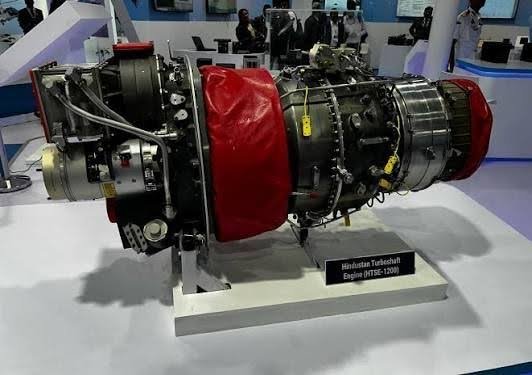
A major step toward achieving total self-reliance in rotorcraft propulsion systems has been taken by Hindustan Aeronautics Limited.
For its 1200 kW class Hindustan Turbo Shaft Engine, the company has started developing an indigenous Full Authority Digital Engine Control system. This move will secure important intellectual property and remove reliance on foreign suppliers.
The Aero Engine Research and Design Center in Bangalore created the HTSE-1200. It is designed for helicopters in the 3.5 metric ton category with single engines and those in the 5 to 8 metric ton category with twin engines. It produces 1200 kW of power at sea level. Because of its adaptability, it may be used on a variety of military and commercial rotorcraft platforms.
By substituting a digital computer for conventional hydromechanical controls, the FADEC system represents a technological advancement. This makes it possible to precisely optimize engine performance and fuel flow, guaranteeing increased dependability and efficiency.
The device improves safety and lessens pilot fatigue by automating crucial tasks, especially in difficult operating settings like high-altitude operations.
Additionally, the implementation of FADEC will enhance operational limitations, allowing helicopters powered by the HTSE-1200 to operate more efficiently under a variety of circumstances. This is particularly crucial for India’s armed services, which need reliable propulsion systems for operations in difficult environments like mountains.India’s Defense Strategy
The domestic FADEC development guarantees India’s control over a crucial component of aero-engine technology in addition to providing operational advantages. Advanced engine control systems have historically been difficult to get due to prohibitions on foreign exports, which has made supply chains vulnerable.
HAL guarantees that future helicopter applications won’t be limited by outside dependencies by creating its own system.
This project expands on HAL’s larger aerospace propulsion indigenization approach. The addition of FADEC enhances the technological base of the HTSE-1200, which is already a historic project. When taken as a whole, they mark a significant advancement in the creation of an entirely domestic helicopter engine ecology.
Additionally, FADEC’s development is in line with India’s national objectives under the Aatmanirbhar Bharat plan. By becoming proficient in such intricate technologies, the nation strengthens its strategic independence and establishes itself as a reliable participant in the international aerospace industry.
Future expansion is greatly aided by the capacity to develop, produce, and manage cutting-edge propulsion systems at home.
The advancements made by HAL in this field are a result of years of research and design expenditure. Leading these initiatives has been the Aero Engine Research and Design Centre, and the HTSE-1200 project shows how developed India’s aero-engine capabilities are.
This accomplishment will be further enhanced by the FADEC technology, which guarantees that India’s helicopters have cutting-edge propulsion controls.
An important milestone in India’s aerospace history will be the incorporation of FADEC into the HTSE-1200. In addition to improving rotorcraft performance and safety, it will represent the nation’s commitment to achieving technical sovereignty in vital defense areas.