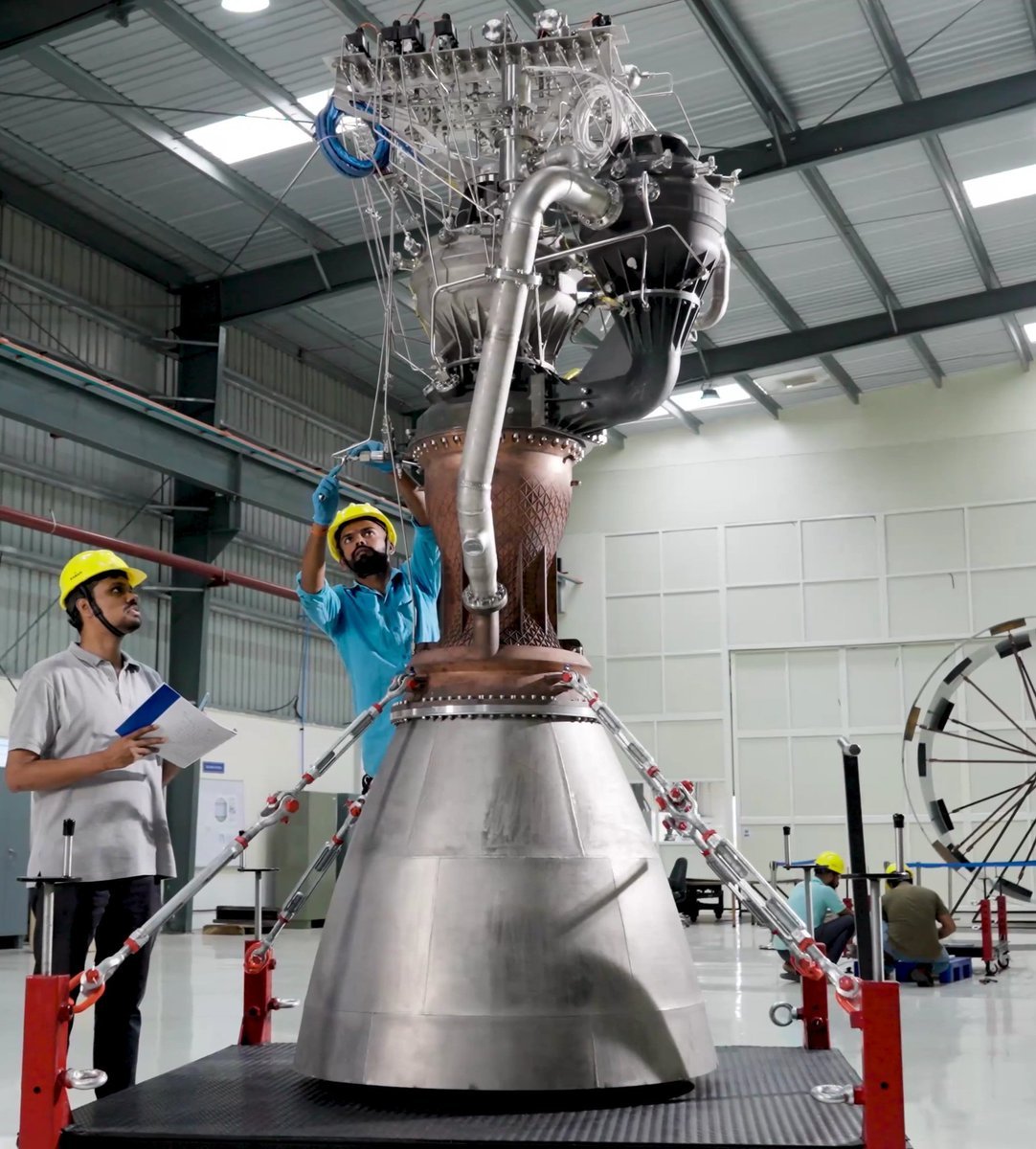
The first completely integrated full-flow staged combustion (FFSC) rocket engine in India, Everest, was unveiled by Astrobase Space Technologies.
Designed and produced in Bangalore, the 800 Kilonewtons-class methalox engine represents a significant advancement for India’s commercial space industry and places the nation among a small number of countries capable of developing this extremely complicated propulsion technology.
On August 7, 2026, Astrobase unveiled Everest, establishing it as the first fully integrated FFSC engine in India. The engine can lift 80 tons under vacuum thanks to its 800 kilonewtons of thrust rating. It is powered by methalox, a propellant mixture of liquid oxygen and liquid methane that burns cleaner than kerosene and is more appropriate for reusable launch vehicles.
One of the most sophisticated rocket engine designs is the FFSC cycle. Fuel and oxidizer are directed thru different pre-burners in this system before going into the main combustion chamber.The past
This procedure guaranties that every propellant is completely gasified, allowing for severe chamber pressures of more than 300 bar, more efficiency, and less component stress. In comparison to traditional staged combustion systems, the end product is an engine with greater performance, a longer lifespan, and many reuses.
Prior to this unveiling, Astrobase has already accomplished a number of significant milestones. In September 2025, a sub-scale hot-fire test was carried out; in January 2026, high-speed turbopump experiments took place.
At its 21.5-acre propulsion test facility in Anantapur, Andhra Pradesh, the business now intends to conduct a full-scale hot-fire test later this year.
This location is one of the most sophisticated private test facilities in India, with thrust levels up to 200 tons.
Throttle capability, which enables thrust modulation between 50% and 110%, is incorporated into the engine’s architecture. Reusability and controlled landings depend on this.
In order to launch satellites into low Earth orbit, Astrobase wants to combine several Everest engines on a medium-lift rocket. The first stage will be recovered for further use.
Additionally, once facilities are fully operational, the company hopes to hot-fire one engine per week and produce up to 50 engines annually.
One of Astrobase’s facilities is a 46,000-square-foot assembly and integration facility in Bengaluru that has the biggest industrial metal 3D printer in India. This lowers costs and speeds up development cycles by enabling the quick manufacture of complex core components.
Former ISRO propulsion engineer Devakumar Thammisetty and CoinDCX co-founder Neeraj Khandelwal started the business in 2024.
With the release of Everest, India is now the fourth nation to create an FFSC engine, behind the US, China, and the USSR. The only aircraft in the world to successfully fly using this architecture is SpaceX’s Raptor. India will become a member of a select group of countries that have mastered one of the most technically complex propulsion systems ever created if Astrobase’s next tests are successful.India’s Armed Forces
Only a few weeks have passed since Skyroot Aerospace’s Vikram-1 became India’s first privately produced orbital rocket to reach space on July 18, 2026.
When taken as a whole, these achievements demonstrate how quickly India’s private space sector is expanding, supporting the country’s goals of creating a $44 billion space economy by 2034.
When taken as a whole, these achievements demonstrate how quickly India’s private space sector is expanding, supporting the country’s goals of creating a $44 billion space economy by 2034.
Additionally, the business is striving for launch-on-demand capability, with the goal of delivering dedicated missions within 15 days of pressing national needs.

