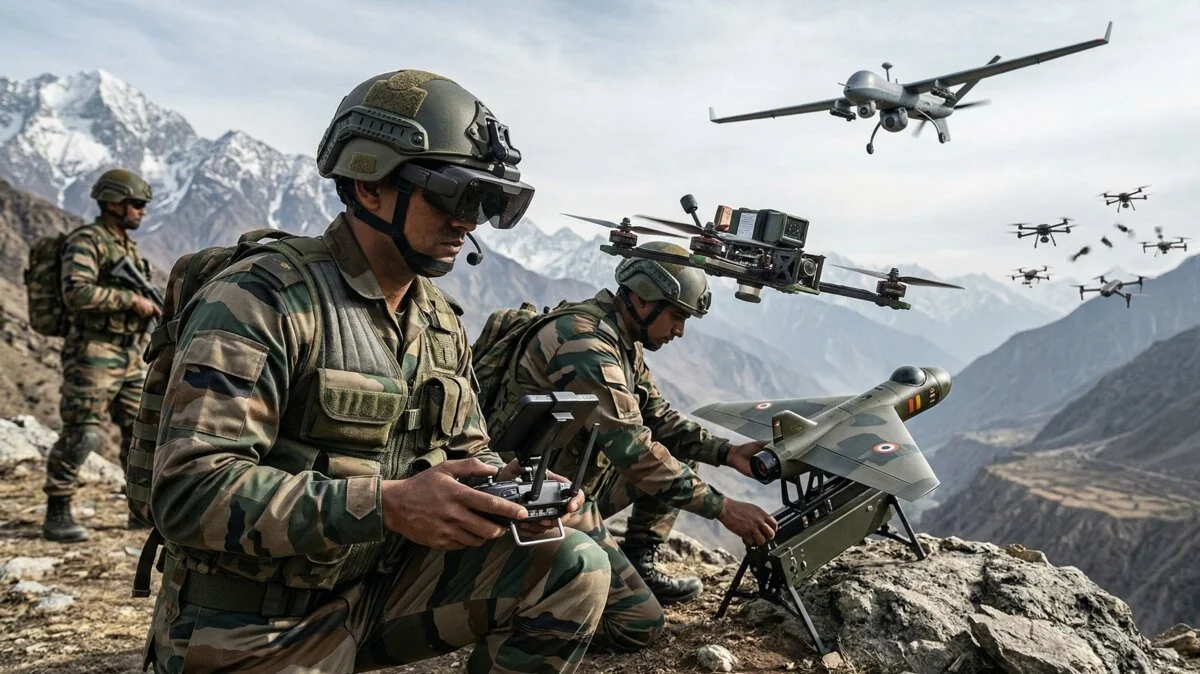
After a competitive evaluation procedure and thorough field testing at up to 17,500 feet, the Indian Army has ordered 225 First-Person View (FPV) drones from Gurgaon-based Aerodrone Robotics Pvt Ltd.
The acquisition is a component of the Army’s broader modernization initiative and highlights the growing significance of unmanned systems in harsh operational settings near India’s western and northern borders.
Key operational requirements, including as endurance, speed, accuracy, and overall combat performance, were used to evaluate the drones.
The terrain used for the trials was very similar to that of troops stationed near the Line of Actual Control with China and the Line of Control with Pakistan.
Because Indian forces frequently operate between 12,000 and more than 18,000 feet, notably in the Siachen Glacier region, high-altitude deployment is especially important.
From smaller tactical units like Ashni platoons to larger Battlefield Air Support battalions, the Army is gradually developing a layered unmanned capability.
There are significant technical difficulties when using drones in the Himalayas.
Additionally, propulsion systems are under more stress due to the thinner environment.
Extreme cold makes procedures much more difficult.
Another important consideration is the dependability of communication.
The Army has carried out extensive trials with Indian drone manufacturers in Ladakh and the Himachal Pradesh district of Spiti to address these issues.
The assessments, which concentrated on logistics and FPV drone categories in particular, allowed the Army to find systems that could be purchased while also pointing out areas that needed more development.
The value of unmanned systems in surveillance, logistical, precision-strike, and communications tasks has been shown by the increasing significance of drones in conflicts like the war in Ukraine and the conflict involving Israel.
The contract calls for the drones to be supplied by Aerodrone Robotics, a company that specializes in military unmanned aerial systems.
The company claims that its platforms use in-house software and are military-hardened.
By encouraging domestic, field-tested drone technologies that can function successfully in some of the most difficult high-altitude battlefields in the world, the order helps India’s larger Atmanirbhar Bharat plan and strengthens the Army’s growing employment of unmanned systems.