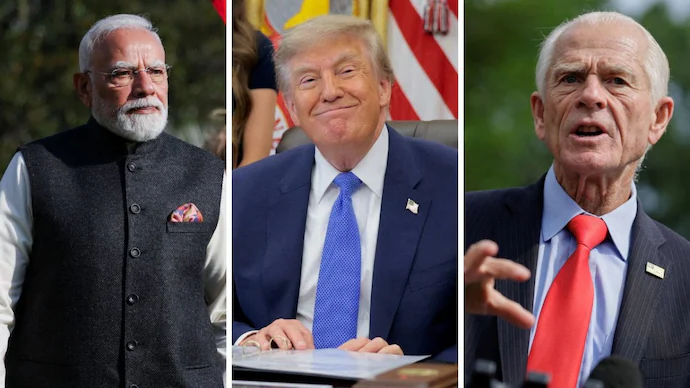
According to Peter Navarro, a senior US presidential counselor, President Donald Trump and Prime Minister Narendra Modi have a very positive working relationship and will find a solution to the tariff issue pertaining to Russian oil.
His comments coincided with the United States and India’s continued efforts to deepen their multifaceted alliance across key fields.The past
However, India was deeply involved in the fight after it started, selling refined goods on Russia’s behalf to support Moscow’s military effort. Although his post had provoked strong online reactions from Indian readers, he pointed out that this issue has subsequently been remedied. He emphasized that difficulties in America are settled differently and recommended that such conflicts should not be handled thru aggressive exchanges.
In response to an inquiry from ANI, Navarro reaffirmed that President Trump and Prime Minister Modi would negotiate the tariff issue directly. He emphasized that neither he nor any organization should meddle in the bilateral talks, highlighting the close relationship between the presidents.
The remarks came after the US Senate passed the Lindsey O. Graham Sanctioning Russia and Iran Act of 2026 on August 7.
President Trump is authorized to slap tariffs of up to 100% on commodities from nations like China and India that continue to buy Russian gas and oil under the bipartisan legislation, which was approved by a resounding 86-11 majority.
Targeting countries with substantial energy trading connections to Russia, the measure is intended to increase economic pressure on Moscow and Tehran.
The clauses provide the US president the option to impose taxes on imports from the top five global consumers of Russian natural gas or crude oil.
Additionally, the bill imposes new penalties on Russian President Vladimir Putin, high-ranking military and political figures, financial organizations, energy advancements, and organizations associated with Russia’s war effort.
It imposes limitations on older, reflagged oil tankers that are purportedly used by Russia to evade international sanctions and preserve export earnings. Reducing the cash flows supporting Russia’s economy and military campaign is the larger goal.
Along with China, India continues to be one of the world’s biggest consumers of Russian crude.
Following the start of the Russia-Ukraine conflict in 2022, India increased its purchases of cheap Russian crude. During the turbulent worldwide market, the action was intended to secure the country’s energy needs.
Although Russia was not India’s main supplier in the past, the availability of less expensive crude enabled Indian refiners to maximize raw material costs and guaranty continuous domestic supply. This was especially crucial in light of the Strait of Hormuz transit problems and the volatility of the world’s energy markets.
The issue of tariffs now forms a critical element in India-US relations, with both governments seeking to reconcile strategic cooperation with economic realities.
Navarro’s guaranty that Trump and Modi would settle the issue shows faith in the strength of the bilateral alliance even in the face of fresh difficulties in the world energy scene.
