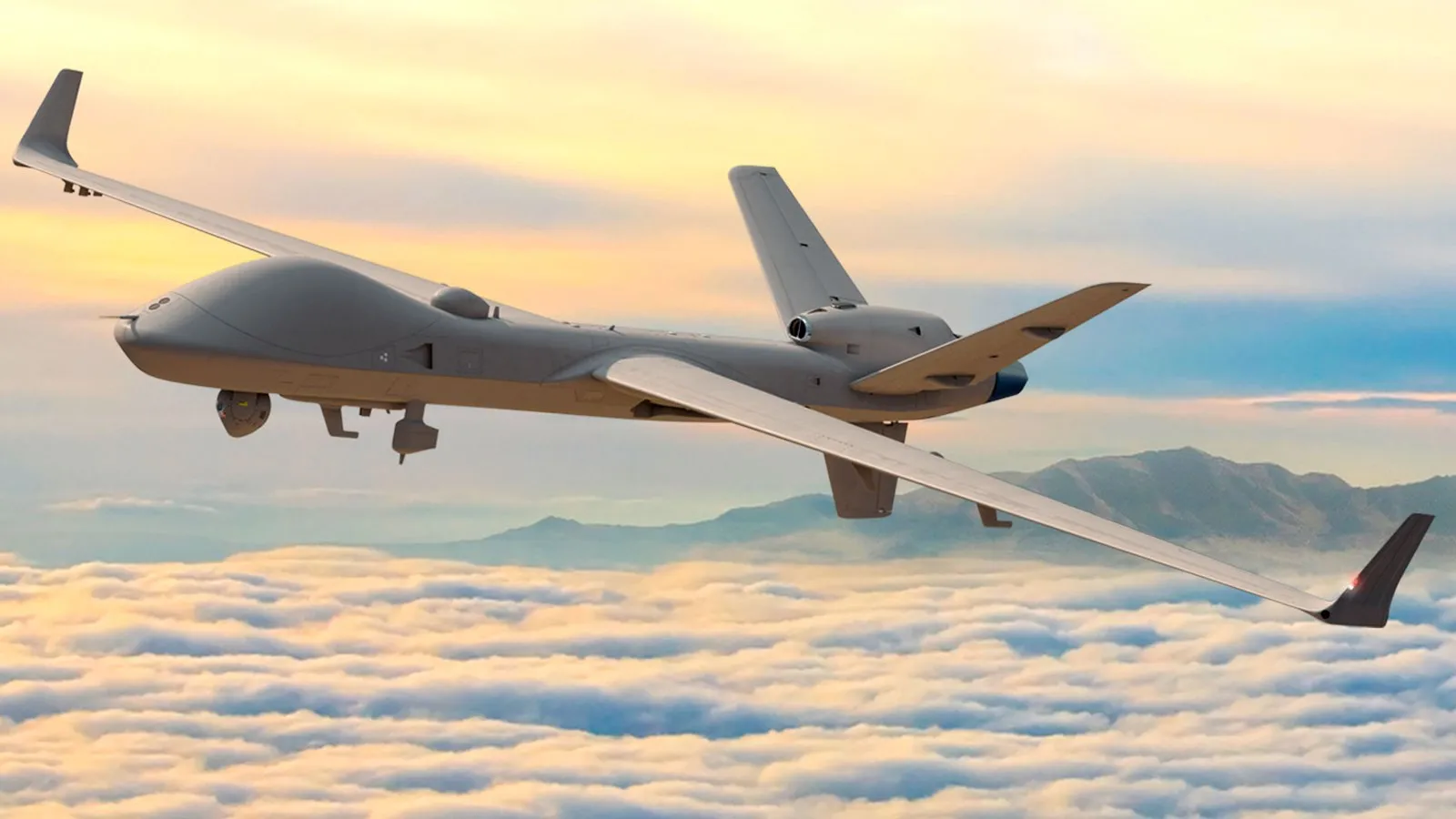
According to Money Control, India is developing its unmanned aviation capabilities in two parallel ways: by acquiring cutting-edge American MQ-9B drones and by continuing to build its own TAPAS BH-201.
Despite being long-range military drones intended for surveillance operations, their capabilities, levels of development, and strategic goals differ greatly.
One of the most advanced remotely piloted aircraft in the world is the MQ-9B, which is produced in the US by General Atomics Aeronautical Systems.
With the SeaGuardian platform, the Indian Navy has already gained operational experience.
In contrast, the Aeronautical Development Establishment of the Defense Research and Development Organization has developed the TAPAS BH-201 domestically.
Endurance and operating altitude show the most performance disparity.
TAPAS has proven to be able to operate at altitudes of up to 28,000 feet and endure for over 18 hours.
Payload capacity reveals an even greater disparity between the two systems.
The flexibility of the mission is directly impacted by this disparity.
A far wider variety of surveillance equipment, especially for maritime activities, can be installed on the SeaGuardian.
Additionally, the MQ-9B has shown promise in anti-submarine warfare.
Armament is arguably the most important differenceAGM-114R Hellfire missiles, along with other armaments and related equipment, were approved by the US for India’s MQ-9B procurement.It has not been stated that TAPAS is a functional armed drone.
Therefore, it is oversimplified to say that TAPAS is India’s version of the MQ-9B.
Therefore, it is oversimplified to say that TAPAS is India’s version of the MQ-9BTherefore, claiming that TAPAS is India’s equivalent of the MQ-9B is simplisticThe airframe, avionics, flight-control systems, landing gear, and communications linkages are among the essential components of the platform that have been contributed by Indian industry.
.Future generations of Indian military drones can benefit from the rich technical experience produced by this indigenous development pathway.
Another benefit of the MQ-9B is its operational maturity.
In contrast, TAPAS has had to tackle the much more challenging task of building an indigenous capability from the bottom up.
According to recent advancements, the lessons acquired from TAPAS are also influencing more recent Indian unmanned aircraft projects, such as next-generation platforms meant to provide improved endurance, cargo capacity, and possible weaponization choices.
A dual-track strategy is seen in India’s choice to pursue both planes.
By assisting India in developing competence in unmanned aviation, autonomous flying, sensors, communications networks, and mission-control technology, TAPAS advances a longer-term national goal.
In terms of endurance, altitude, payload capacity, and combat capability, the MQ-9B is still unquestionably superior as of right now.
When taken as a whole, the two initiatives show how India is striking a balance between its urgent operational needs and its goal of creating a drone ecosystem that is more technologically sophisticated and self-sufficient.
.
.

