India’s undersea capabilities have advanced significantly with the development of the High Endurance High Endurance Autonomous undersea Vehicle, or HEAUV, by DRDO’s Naval Science and Technological Laboratory (NSTL).India’s Defense Strategy
Operating at a depth of 300 meters, this 6-ton, roughly 10-meter-long platform with a 1-meter diameter can last up to 15 days at 3 knots (maximum speed of 8 knots).
It has sophisticated sonars, modular swappable payloads, demonstrated dynamics in surface/submerged trials, and is intended for roles such as anti-submarine warfare, mine countermeasures, ISR, and bathymetryThe goal of the HEAUV’s creation was to give a mother ship an efficient means of expanding its operating reach into disputed or inaccessible waters.
By using autonomous technologies rather than crewed vessels, this strategy lowers the risk to human life and safeguards valuable assets.
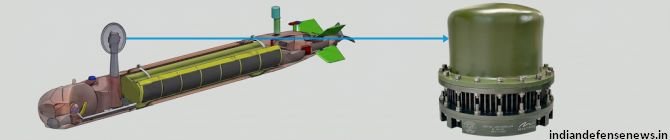
The HEAUV’s radar system is a portable, low-power X-band surveillance radar that helps the vehicle with intelligence, surveillance, and reconnaissance tasks. Its goal is to improve situational awareness and mission effectiveness by periodically detecting and tracking subsurface targets.
Targets like boats, ships, channel markers, and buoys can be detected thanks to the radar system’s sea surface surveillance capabilities. This guarantees that the HEAUV can operate in a safe manner and steer clear of collisions.
For autonomous underwater missions when endurance and efficiency are crucial, the design is optimized for Size, Weight, and Power (SWaP), making it lightweight, portable, and energy-efficient.
Complete 360-degree azimuth coverage is provided by a cylindrical slotted waveguide antenna, guaranteeing thorough environmental monitoring. By using a blind mating technique, the system simplifies integration with the car and does away with the requirement for interior cabling. The radar is enclosed in a Radome with a hydrophobic coating that improves performance during underwater operations and is rated to withstand pressures up toThe radar uses element-level digital beamforming and multi-layered RF boards to increase signal processing efficiency and detection accuracy. Its flexibility is further improved by sector-based electronic scanning, which enables the system to concentrate on particular regions of interest as needed by mission specifications. Because of its adaptability, the HEAUV can function well in a variety of maritime settings.
45 barSimplifying the architecture and lowering hardware complexity, the signal processor and radar data processor functions are combined into a single proprietary system-on-a-chip board. This integration enhances the radar’s dependability and small size, which makes it ideal for autonomous platforms with constrained power and space.
One of the system’s distinguishing characteristics is its ease of use. It runs on batteries, is easy to install, and requires little upkeep. Because of these characteristics, it is very useful for deployment in demanding operating circumstances where quick setup and consistent performance are crucial.
.
.