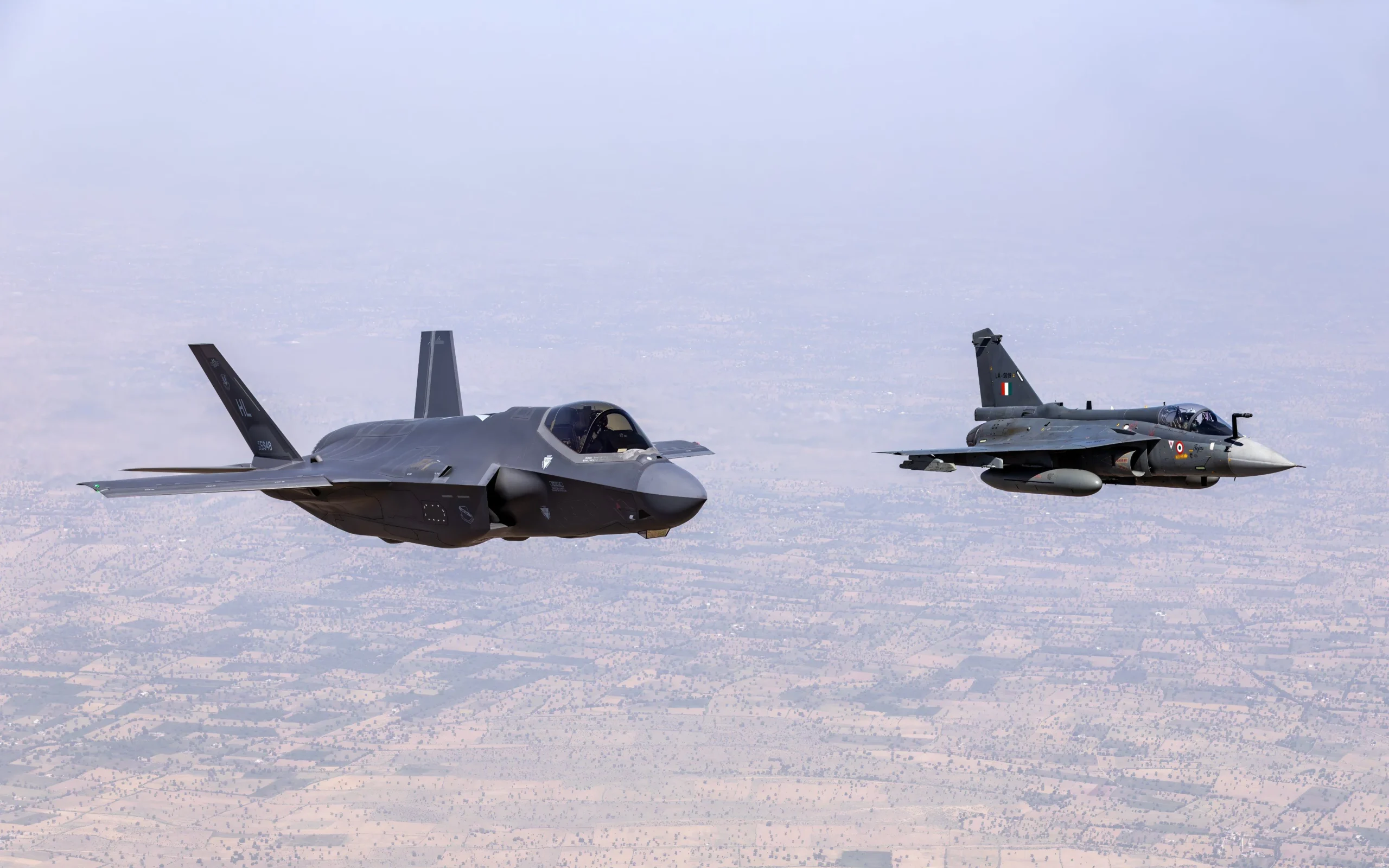
An important milestone in India-US military cooperation has been reached with the arrival of US Air Force F-35 Lightning-II stealth fighters at Exercise Tarang Shakti 2026. This is the first time that America’s most cutting-edge fifth-generation combat aircraft have taken part in air drills on Indian soil, according to SCMP.
The multinational exercise, taking place at Jodhpur Air Force Station in Rajasthan, around 200km from the Pakistan border, runs from 26 September until 12 October and has brought together air forces from more than 40 nations, including active participants from the United States, Australia, France, Germany, the United Arab Emirates, Bangladesh and Sri Lanka.
Over 200 US Air Force troops and six F-35 warplanes have been sent in for the exercise, demonstrating the increasing operational cooperation between Washington and New Delhi.
As India continues to work on its domestic Advanced Medium Combat Aircraft (AMCA) stealth fighter project, the F-35’s presence offers a unique chance to witness a frontline fifth-generation combat aircraft in a realistic operating scenario.
The F-35’s integration of sensors, networking, and ba
ttlefield data-sharing into combat operations—capabilities considered essential to contemporary air warfare—is likely to be thoroughly examined by Indian Air Force specialists.
According to analysts, the exercise will also enable India to contrast Western network-centric air power concepts with a fleet that presently consists of French Rafales, Russian-built Su-30MKI fighters, and domestic TEJAS planes.
When operating alongside the Su-30MKI, which continues to be the mainstay of India’s combat aviation fleet, the Indian Air Force is anticipated to pay close attention to how well the F-35 performs.
According to military observers, the exercise provides a real-world chance to evaluate how aircraft from various eras and technological backgrounds can cooperate during challenging missions.
Additionally, the exercises offer insightful information about cross-platform coordination, command-and-control integration, and interoperability—all of which are becoming more crucial in high-intensity conflict situations.The United States is unlikely to reveal the F-35’s most sensitive capabilities during the exercise, experts warn.
It is generally accepted that the aircraft are flying with radar-enhancing reflectors that hide their actual stealth profile and make it impossible for other forces to measure their low-observable features.
The fighter’s complete electronic warfare and countermeasure capabilities, which are still among its most carefully held operational secrets, are also not anticipated to be disclosed by Washington.
Nevertheless, the aircraft’s flight performance, maneuverability, mission planning procedures, and operational concepts are probably going to become more evident to Indian pilots and planners.
The exercise is also beneficial to the United States, whose pilots will see an air force that uses a variety of Western, Russian, and indigenous platforms and acquire experience operating alongside and against Indian aircraft, especially the highly maneuverable Su-30MKI.
Nevertheless, defence cooperation has shown surprising endurance, with recent acquisitions such as the US-made FGM-148 Javelin anti-tank guided missile system demonstrating that military links continue to strengthen.
Despite sporadic political differences, both nations strategically concur on key Indo-Pacific security issues, which creates significant incentives to increase defense engagement.
India is a crucial ally in preserving peace and stability in the Indo-Pacific area, according to US strategic documents.
Exposure to the most extensively used fifth-generation fighter in the world might provide India important lessons for the AMCA program, especially in areas like sensor fusion, stealth integration, and cooperative combat operations.
The deployment demonstrates the breadth of bilateral military cooperation and reaffirms Washington’s commitment to fortifying security alliances in the Indo-Pacific.
In the end, the F-35’s presence during Tarang Shakti 2026 highlights the growing significance of India-US defense cooperation in a rapidly changing regional security environment and serves as both a useful learning opportunity and a potent show of strategic confidence.