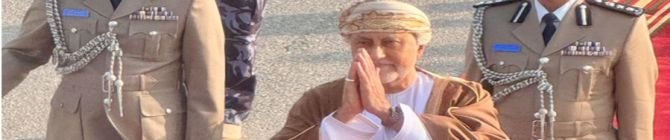
Sayyid Shihab bin Tariq Al Said, Oman’s Deputy Prime Minister for Defense Affairs, said Prime Minister Narendra Modi farewell with an emotional “Namaste” at the end of the Indian leader’s two-day visit to Muscat.
The deep warmth and cultural connection between the two countries were shown by this traditional Indian gesture. The symbolic performance, which combined Indian customs with Omani hospitality, demonstrated the strength of bilateral connections.
Prime Minister Modi was personally dismissed on Thursday by Sultan Haitham bin Tarik Al Said’s brother, Sayyid Shihab bin Tariq Al Said. A significant turning point in India-Oman ties was marked by the visit, which was full of meaning and symbolism. It also marked the end of 70 years of diplomatic relations between the two nations.
The signing of the Comprehensive Economic Partnership Agreement (CEPA) was a significant accomplishment during the visit. The agreement was formalized by Oman’s Minister of Commerce, Industry, and Investment Promotion, Qais bin Mohammed Al Yousef, and Commerce and Industry Minister Piyush Goyal. By creating new opportunities for commerce, investment, and mutual prosperity, this agreement is expected to strengthen economic cooperation.
Sultan Haitham bin Tarik Al Said presented Prime Minister Modi with the esteemed “Order of Oman.” The award honors Modi’s outstanding efforts to improve relations between India and Oman as well as his inspiring leadership on the international scene. The award was established in 1970 by the late Sultan Qaboos bin Said and is given to a few international leaders who have improved bilateral relations and public service.
Prime Minister Modi emphasized the award’s importance as a celebration of the long-standing friendship between Oman and India as he dedicated it. He explained it as a manifestation of the love that the 1.4 billion people of India and the Omani people had in common. The conferment’s significance was increased by its timeliness, which coincided with seven decades of diplomatic history.
High-level talks on defense, security, and regional stability demonstrated how the visit strengthened the two countries’ strategic alliance. India’s dedication to marine security in the Indian Ocean region is shared by Oman, a significant participant in the Gulf. In the face of shifting geopolitical conditions, more collaboration in these fields offers to strengthen shared interests.
The agenda was dominated by economic issues, and the CEPA has the potential to increase bilateral commerce above its existing levels. Industries including technology, logistics, and energy stand to gain a great deal. The deal supports Oman’s ambitions to diversify away from its reliance on oil and India’s ‘Make in India’ campaign.
The success of the tour was further enhanced by cultural exchanges. Sayyid Shihab bin Tariq Al Said’s “Namaste” gesture represented respect for one another and ties between individuals. Over 700,000 Indian expats live in Oman and play a crucial role in the Sultanate’s economy and society.
Prime Minister Modi also interacted with the Indian diaspora and business leaders in Oman. These gatherings investigated prospects for cooperation and promoted kindness. The visit’s outcomes, which combine tradition with forward-thinking tactics, mark the beginning of a new chapter in India-Oman ties.
The acts of solidarity made a lasting impression when Prime Minister Modi left Muscat. In addition to honoring historical relationships, the two-day visit set the stage for future collaborations. India and Oman come out stronger, bound together by strategic convergence and common values.